AI Instructional Guidance Built on
WIDA CAN DO Descriptors
Melaa is licensed to use the WIDA CAN DO Descriptors, Key Uses Edition - building instructional guidance directly on this framework for supporting multilingual learners.
What is WIDA?
WIDA is a research-based organization housed at the University of Wisconsin–Madison that provides language development standards, assessments, research, and professional learning for educators of multilingual learners. WIDA's mission is to advance academic language development and academic achievement for linguistically diverse students.
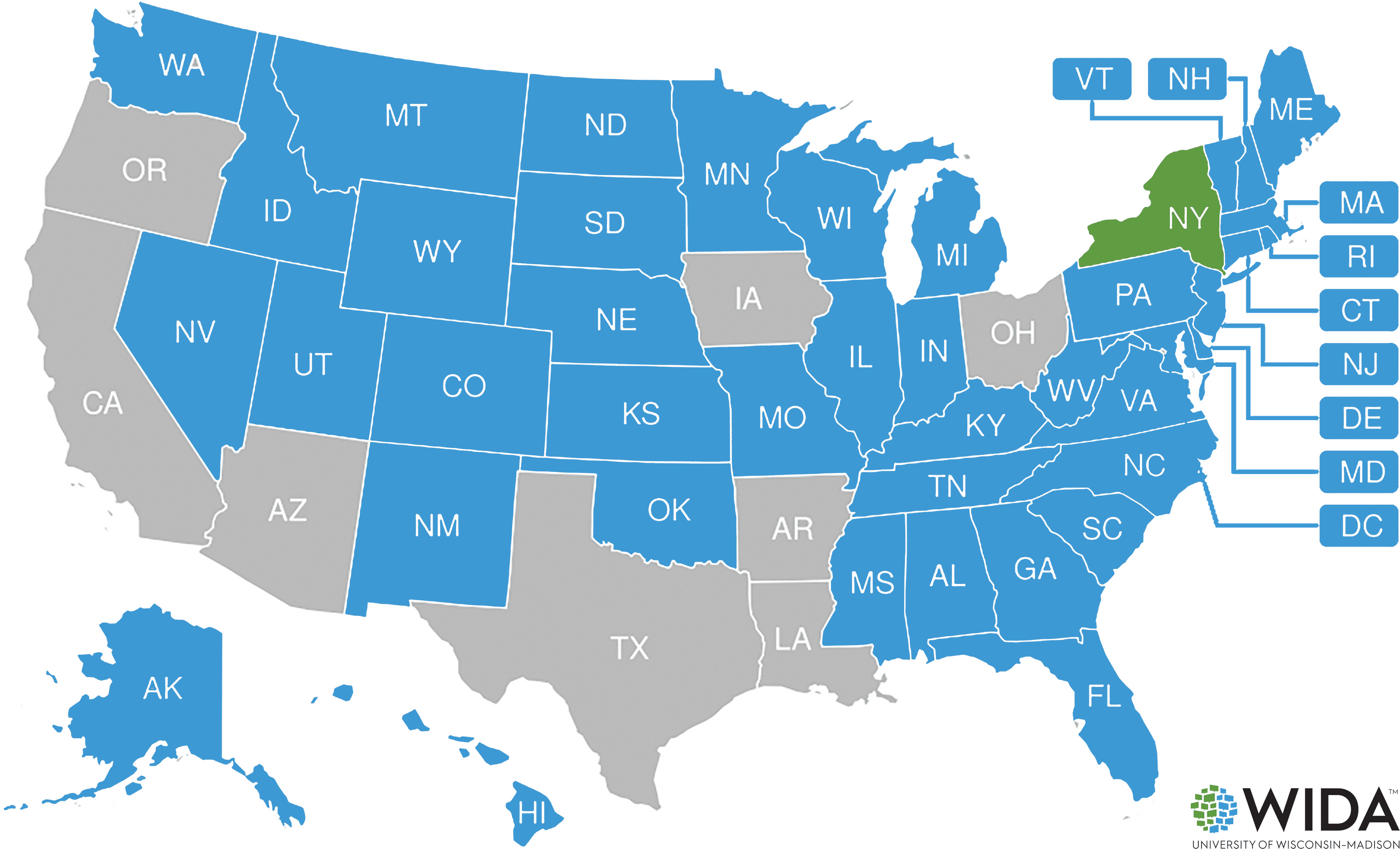
Used by 42 U.S. states, territories, and federal agencies and internationally, WIDA serves over 2.5 million multilingual learners through its suite of standards and assessments. The WIDA ACCESS for ELLs assessment is the most widely used English language proficiency test in the United States, providing critical data about students' language development across Listening, Speaking, Reading, and Writing domains.
WIDA's framework is grounded in the CAN DO Philosophy - a strengths-based approach that focuses on what students can do with language at each proficiency level, rather than what they cannot. This asset-based philosophy drives instructional practice that values multilingual learners' linguistic and cultural resources.
WIDA Consortium Membership
The WIDA Consortium includes 42 U.S. states, territories, and federal agencies that use the WIDA ACCESS for ELLs assessment and WIDA ELD Standards Framework. As the largest consortium of its kind, WIDA provides a shared framework for supporting multilingual learners across the country.
CAN DO Descriptors, Key Uses Edition
The CAN DO Descriptors, Key Uses Edition (2016) describe what multilingual learners can do with language, with support, at each of the six proficiency levels. They are examples to guide planning and conversation, not an exhaustive list, and not a checklist, curriculum, or assessment. WIDA notes that the Can Do Descriptors have not yet been updated to reflect the 2020 Edition of the ELD Standards Framework and that they supplement, rather than replace, the ELD Standards Statements. Their four Key Uses (Recount, Explain, Argue, Discuss) are a different set from the 2020 Framework's Key Language Uses (Narrate, Inform, Explain, Argue); Melaa never maps one onto the other.
Recount
Display knowledge or narrate experiences and events
Explain
Clarify the “why” or the “how” of ideas, actions, or phenomena
Argue
Persuade by making claims supported by evidence
Discuss
Interact with others to build meaning and share knowledge
These descriptors are organized across six grade bands (K, 1, 2–3, 4–5, 6–8, 9–12) and six proficiency levels (Entering, Emerging, Developing, Expanding, Bridging, Reaching), giving educators a precise picture of what their students can do and what to target next.
Why Licensed Content Matters
Authentic, Verified Content
Melaa uses the actual, licensed CAN DO Descriptors - not summaries, paraphrases, or AI-generated approximations. When you look up a student's descriptors, you see exactly what WIDA has published for that grade band, domain, and proficiency level.
AI Recommendations You Can Trust
Our AI Thought Partner receives the student's actual CAN DO Descriptors as context for every conversation. This means scaffolding suggestions, lesson modifications, and differentiation strategies are grounded in the licensed CAN DO Descriptors - not generic language learning advice.
Built on Licensed Content
Melaa is licensed to use the WIDA CAN DO Descriptors, Key Uses Edition, building its instructional guidance directly on this framework rather than on summaries or generic language-learning advice.
See WIDA CAN DO Descriptors in Action
Enter any student's ACCESS scores and get instant CAN DO Descriptor profiles with AI-powered instructional strategies.
Learn more about WIDA and their work at wida.wisc.edu